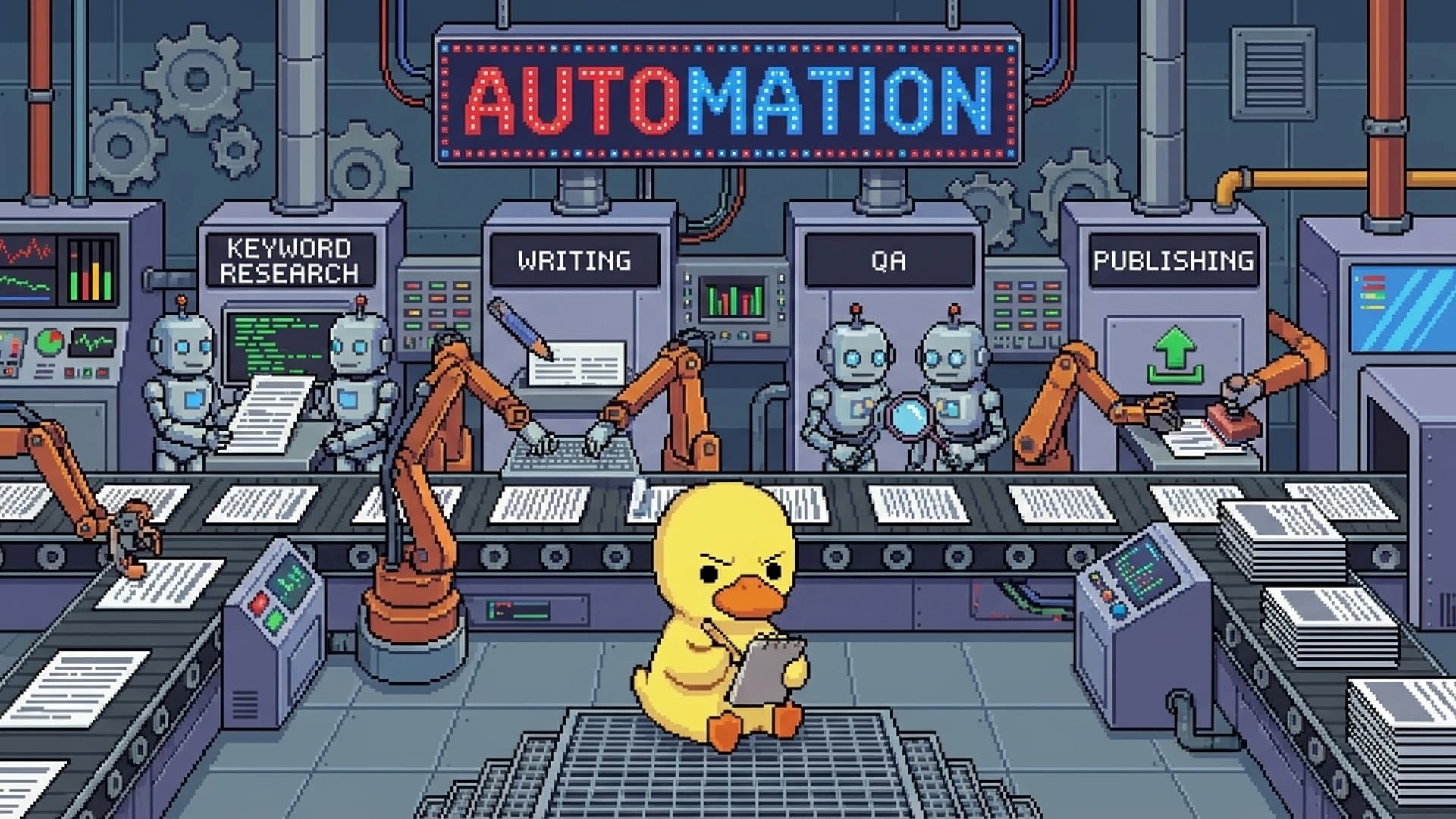
You know the drill. Research keywords Monday. Write a brief Tuesday. Draft Wednesday. Edit Thursday. Publish Friday. Next week, do it all again. And again. And again. SEO automation is what happens when software handles that entire loop for you. Keyword research, content creation, technical audits, internal linking, reporting — all running without you babysitting every step. The question isn't whether you should automate. It's how much of the pipeline you're ready to hand over, and what the different levels of automation actually look like.
SEO automation ranges from simple rank tracking to fully autonomous AI agents. Modern agents can automate 80%+ of SEO execution at $3-5 per published article, compared to $500-2,000 from agencies. There are four levels: manual tools, AI-assisted tools, workflow automation, and autonomous agents. The key is automating execution while keeping strategy and brand voice human.
What You'll Learn
- The four levels of SEO automation, from manual tools to autonomous AI agents
- Every SEO task that can be automated and the specific ones that should stay manual
- Real cost comparisons: DIY vs freelancer vs agency vs AI automation for 15 posts per month
- How the full automated pipeline works from keyword research to published content
- Why autonomous agents are fundamentally different from SEO tools
- A step-by-step implementation path that doesn't sacrifice quality

The four levels of SEO automation
Not all automation is the same. The market has evolved through four distinct levels, and each one changes how much of the pipeline runs without you. Here's a simple way to think about it.
Level 1: Manual SEO with individual tools
You use Ahrefs for keywords, Google Search Console for tracking, Screaming Frog for audits, Google Docs for writing. Each tool automates one narrow function. But you're the glue connecting them. You manually export data, manually write briefs, manually assign writers, manually upload to the CMS. The tools save time on individual steps. The workflow is entirely on your shoulders. Cost: $200-500/month in tools, plus 40-60 hours of your time.
Level 2: AI-assisted automation
SurferSEO scores your content while you write. Jasper generates draft copy from prompts. Semrush suggests keywords based on your domain. The AI accelerates each step by 40-60%, but you still orchestrate everything. You decide what to write, when to publish, and how to distribute. Think of it as a faster employee, not an independent operator. Cost: $300-800/month in tools, plus 25-40 hours of your time.
Level 3: Workflow automation
Zapier triggers a content brief when a keyword hits a score threshold. Make.com pipes keyword data into a generator, then pushes the output to your CMS. n8n chains research, writing, and publishing together. You build the workflow once, then it runs on schedule. The limitation: these workflows are brittle. They break when APIs change, can't handle edge cases, and don't learn from results. Cost: $500-1,500/month, plus 10-20 hours for maintenance.
Level 4: Autonomous AI agents
This is where things get fundamentally different. An autonomous agent doesn't follow a fixed workflow. It makes decisions. It researches keywords, evaluates opportunities against your domain's strengths, writes content in your brand voice, handles images and schema markup, publishes, builds internal links, and monitors performance. Your role shifts to strategic oversight: approve briefs, review quality, set direction. Cost: $200-500/month, plus 5-10 hours for oversight. This is the approach <a href="/blog/how-ai-seo-agents-automate-your-content-pipeline">AI SEO agents</a> take.

What to automate and what to keep manual
Roughly 80% of SEO execution is automatable. The remaining 20% is where your judgment actually matters. Here's the breakdown.
Fully automatable tasks
- <strong>Keyword research and scoring:</strong> APIs from DataForSEO, Ahrefs, and Semrush provide volume, difficulty, and SERP data. Automated pipelines pull, score, and rank opportunities without human input.
- <strong>Content brief generation:</strong> AI analyzes top-ranking pages, extracts heading structures, identifies gaps, and generates detailed briefs at ~$0.05 per brief vs. $50-100 for a human strategist.
- <strong>Content writing and optimization:</strong> AI within a structured pipeline produces content that ranks. The key is the system around the writing: keyword targeting, SERP-informed outlines, brand voice training, and multi-pass QA.
- <strong>Technical audits:</strong> Screaming Frog, Sitebulb, and cloud tools automatically scan for broken links, missing meta tags, duplicate content, slow pages, and schema errors.
- <strong>Internal linking:</strong> Automated linking scans your content library, identifies related posts, and inserts contextual links. Including retroactive links to new content from existing pages.
- <strong>Rank tracking and reporting:</strong> The first SEO task ever automated. Still the most reliable. Daily tracking, trend aggregation, and automated reports.
Keep these manual
Brand voice and creative direction. AI can execute within guidelines, but you need to set and evolve them. Content strategy and topic selection. Deciding which opportunities align with your business goals requires human context. High-stakes relationship outreach. Automated emails work for volume, but strategic partnerships need a real person. YMYL content review. If you're in health, finance, or legal, mandate expert review for every automated draft. Automate the research. Keep the judgment calls yours.
What this actually costs
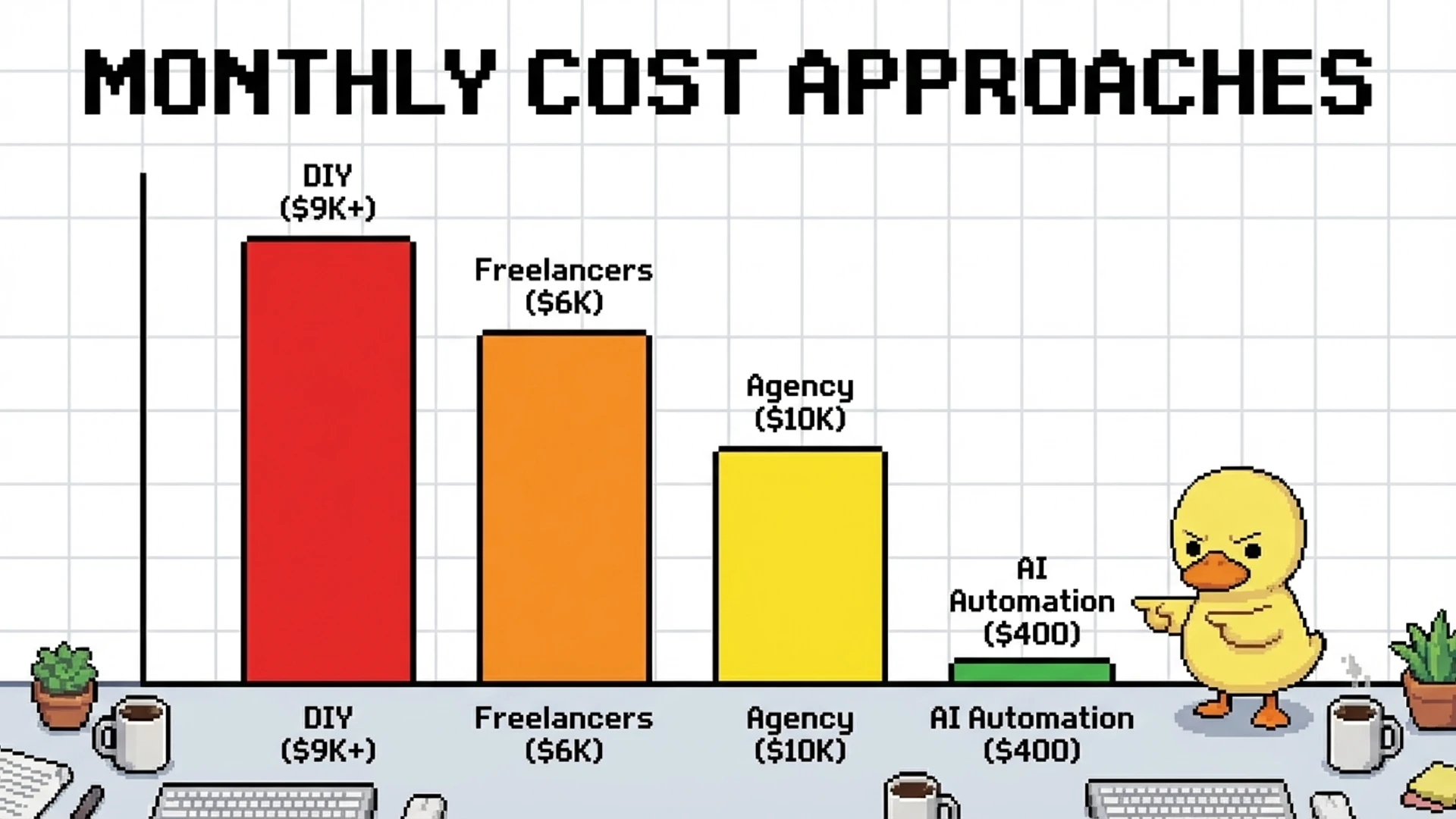
Let's talk real numbers. These are all based on producing 15 optimized posts per month, which is a reasonable velocity for building topical authority.
- <strong>DIY (founder doing SEO):</strong> $200-500/month in tools + 60-80 hours of your time. At a founder's opportunity cost of $150-300/hour, real cost is $9,000-24,000/month. Output: 2-4 posts.
- <strong>Freelance writers:</strong> $300-500 per article x 15 = $4,500-7,500/month, plus tools, plus 15-20 hours managing them. Variable quality.
- <strong>SEO agency:</strong> $5,000-15,000/month retainer for 4-8 posts, audits, and reporting. Per-article cost: $625-3,750.
- <strong>AI automation (Level 4):</strong> $200-500/month platform + ~$67 in API costs (15 x $4.50). Total: $267-567/month. Plus 5-10 hours for oversight. Per-article cost: $18-38 all-in.
That's not a typo. After 12 months, an agency produces roughly 72 posts for $120,000. AI automation produces 200 posts for $5,000. But the real advantage isn't just cost. It's velocity. 200 posts targeting 200 keywords builds topical authority 3x faster than 72 posts ever could. The compound effect is what makes this a different game entirely.

See how duqky's CMO agent and specialist workers — Content, Outreach, and Technical — automate the full marketing pipeline with built-in quality controls and human approval checkpoints.
See how it works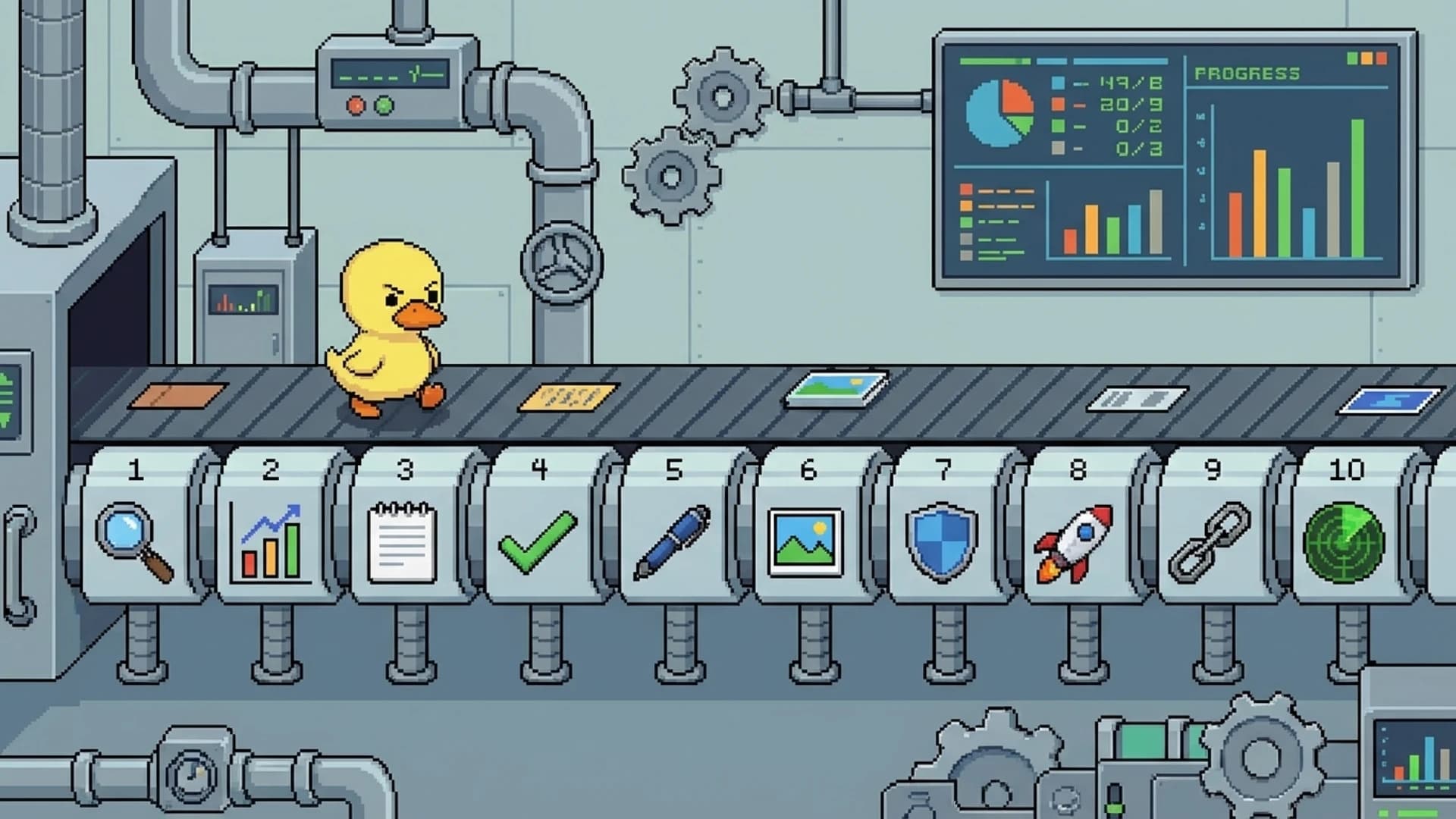
The full automated pipeline, end to end
Here's what Level 4 looks like when it's actually running. This is the autonomous approach, and it's what the most advanced SEO automation delivers today.
- <strong>Keyword discovery:</strong> Agent pulls data from SEO APIs, scores opportunities on volume, difficulty, relevance, and topical fit.
- <strong>SERP analysis:</strong> For each target keyword, the agent analyzes top-10 pages. Headings, word counts, content gaps.
- <strong>Brief generation:</strong> Structured brief with outline, target keywords, internal linking opportunities, and a unique angle.
- <strong>Human approval:</strong> You review the brief. Approve, reject, or modify. This is the single human checkpoint.
- <strong>Writing:</strong> Full article following the approved brief, incorporating brand voice and SERP insights. 1,500-2,500 words.
- <strong>Image generation:</strong> Featured and in-body images generated and compressed to WebP.
- <strong>QA:</strong> 50-item automated checklist evaluates structure, SEO compliance, and brand voice. Below 45/50 triggers a rewrite.
- <strong>Publishing:</strong> Article pushed to CMS with meta tags, schema markup, and proper URL structure.
- <strong>Internal linking:</strong> System scans existing content and inserts bidirectional contextual links.
- <strong>Monitoring:</strong> Rank tracking at day 7, 14, 30, 60, 90. Alerts on traffic drops. Performance feeds future keyword scoring.
Total human time per article: roughly 5 minutes reviewing the brief. Total cost per published article: roughly $4.50 in API calls. Compare that to 8-12 hours and $300-2,000 per article doing it the old way. The math speaks for itself.

How to get started without sacrificing quality
You don't have to jump to Level 4 on day one. Start with one. Seriously. Here's the path that makes the most sense.
- <strong>Audit your current workflow:</strong> Write down every SEO task you do, how long each takes, and how often. This shows you exactly where automation will save the most time.
- <strong>Start with tracking and auditing:</strong> Set up automated rank tracking and scheduled technical audits. Low risk, high value. You'll wonder why you didn't do this sooner.
- <strong>Add AI-assisted writing:</strong> Use SurferSEO or Frase to speed up content creation with AI guidance on structure and optimization.
- <strong>Try workflow automation:</strong> Connect keyword research to brief generation using Zapier or Make.com. Test with 5-10 articles before scaling.
- <strong>Evaluate autonomous agents:</strong> Once you're comfortable, try a Level 4 solution. Start with a free tier to validate quality before committing.
- <strong>Keep humans in the loop:</strong> At every level, maintain oversight for strategy, brand voice, and quality. Automate execution, not judgment.
The quality safeguard
The risk with automation is always quality. Badly automated content (thin, generic, inaccurate) actively hurts your domain authority. The safeguard: automated QA checklists, human approval checkpoints, and regular content audits. If your pipeline consistently passes a 50-item quality gate, the ROI is overwhelmingly positive.

Frequently asked questions
SEO automation is when software handles repetitive SEO tasks that used to eat up your week. It ranges from simple rank tracking to fully autonomous AI agents that manage keyword research, content writing, publishing, internal linking, and performance monitoring end-to-end.
About 80% of SEO execution can be automated today. Keyword research, content writing, technical audits, rank tracking, and internal linking all run on autopilot with modern AI. Strategy, brand voice, and creative direction still need you. The best approach is human-in-the-loop automation.
The big ones: keyword research and scoring, content brief generation, blog post writing, technical site audits, rank tracking, internal linking, meta tag and schema generation, image creation, and email outreach sequences. Strategy and brand voice should stay with you.
For most companies, yes. AI automation produces 15-20 posts per month for $270-570, compared to $4,500-15,000 for freelancers or agencies producing far less. The compound effect on organic traffic typically shows 3-5x growth within 12 months.
Depends on your level. Keyword research: DataForSEO, Ahrefs, Semrush. Content writing: SurferSEO, Jasper, Frase. Technical audits: Screaming Frog, Sitebulb. Full pipeline automation: duqky (autonomous agents), Search Atlas. Choose based on how much of the process you want to hand off.
A tool is a calculator. An agent is an accountant. The tool helps you do tasks faster, but you still drive the process. An agent operates autonomously within boundaries you set, making decisions about what to research, write, and publish without waiting for you to click a button.

duqky automates your entire SEO pipeline. Keyword research, content writing, publishing, internal linking, and technical audits, all with built-in quality controls and human approval checkpoints. Start free with 500 credits.
Get started free